




The 2026 B2B ABM Playbook: Precision Strategies for Smarter Growth
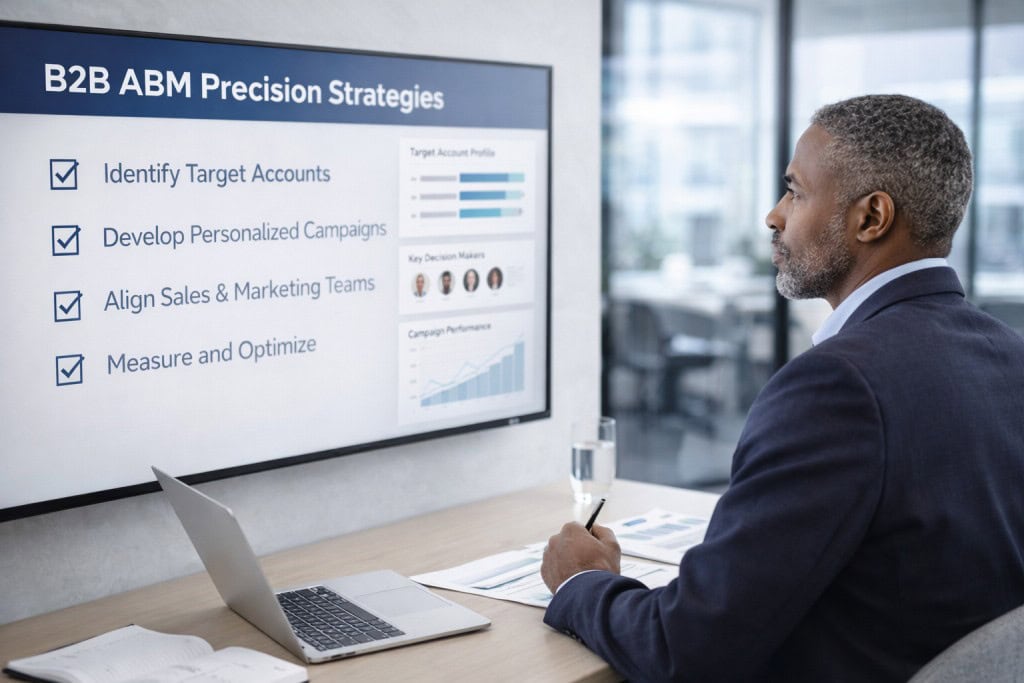
If you’re leading marketing in 2026, you’ve probably felt the shift—and it’s exactly why a B2B ABM strategy has become essential. Buyers are harder to reach, sales cycles are slower, and the “more leads will fix it” mindset is breaking down in real time. Even strong brands are discovering that visibility doesn’t automatically translate into revenue. The truth is, B2B growth has become more selective, more relationship-driven, and more evidence-based.
This is exactly where a B2B ABM strategy earns its keep. Not because it’s trendy. Not because software platforms promise personalization at scale. But because ABM aligns your efforts around the accounts that can actually move the needle—then builds credibility, relevance, and timing around those accounts in a way that supports both marketing and sales.
In this pillar guide, we’ll break down what modern ABM really looks like in 2026—what changed, what didn’t, and how to build a practical playbook that drives smarter growth. You’ll walk away with a clear framework you can apply whether you’re new to ABM or refining an existing program.
Why ABM Matters More in Today’s B2B Buying Environment
B2B purchasing has become a team sport. Decisions involve more stakeholders, more internal debate, and more scrutiny—especially when budgets feel tight or uncertain. At the same time, your prospects are overwhelmed. They see a constant stream of content, outreach, ads, and “quick demos” that all sound similar.
When buyers are overloaded, they don’t reward volume. They reward clarity. They reward credibility. They reward relevance.
That’s why ABM isn’t just “targeting enterprise accounts.” A modern B2B ABM strategy is built to reduce noise and increase signal. It helps you focus your marketing, content, and outreach around the handful of accounts where your value proposition truly fits—then support the buying committee with information they actually trust.
In practical terms, ABM helps you:
- Stop spending time and money chasing the wrong prospects.
- Increase conversion rates across the entire buying journey, not just at the top.
- Build momentum inside accounts where deals are already possible—if trust gets built.
- Create better alignment between sales effort and marketing effort.
From Target Account Lists to a True B2B ABM Strategy
Many ABM programs fail because they start with a list and stop there. They choose “100 dream accounts,” run a few ads, send a few emails, and call it ABM. But lists aren’t strategy. They’re just inventory.
A real B2B ABM strategy has three anchors:
- Account selection with intent (fit, potential, and timing)
- Account understanding (industry pressures, internal priorities, stakeholder concerns)
- Orchestrated engagement (content, outreach, and touchpoints that work together)
In other words, ABM is a precision growth system. It’s not “marketing to accounts.” It’s building a coordinated path to revenue for the accounts that matter most.
This is also where cognitive empathy shows up in a practical way. Cognitive empathy means you understand how your buyer thinks, what they’re trying to avoid, what they need to justify internally, and what “risk” looks like on their side of the table. When you build your ABM approach around that mindset, your messaging stops sounding like marketing—and starts sounding like help.
Alignment First: Why ABM Fails Without Sales and Marketing Unity
If your ABM program is being run only by marketing, it will almost always underperform. Not because marketing isn’t capable—but because ABM requires shared ownership. The goal isn’t engagement. The goal is account progression toward revenue.
In 2026, ABM works best when sales and marketing align on:
- What qualifies as a target account (and what disqualifies one)
- Which stakeholders matter most inside the buying committee
- What “progress” looks like (meetings, multi-threaded engagement, pipeline movement)
- How follow-up happens (speed, personalization, and consistency)
A strong B2B ABM strategy also forces an honest conversation: are we building demand, capturing demand, or both? ABM is powerful because it can do both—but only if you design it intentionally.
And this is where leadership plays a role. ABM isn’t a one-quarter experiment. It’s an operating model. When leadership supports it as a revenue strategy (not a marketing initiative), the organization commits to the consistency required to win high-value accounts.
How AI Strengthens a Modern B2B ABM Strategy
AI can absolutely help ABM—when it’s used as an amplifier, not a replacement for strategy.
Here’s the healthy way to think about it: AI can help you see patterns faster, personalize faster, and respond faster. But it can’t decide what your company stands for, who you should pursue, or what your buyer needs to believe before they’ll commit. That’s still human work.
In a modern B2B ABM strategy, AI is most useful in a few high-leverage areas:
- Intent and signal detection: Identifying accounts showing signs of active research or change.
- Personalization support: Creating drafts, variations, and account-specific messaging frameworks faster.
- Content intelligence: Mapping which topics and proof points perform by segment and stakeholder role.
- Operational speed: Summarizing account activity, call notes, and engagement signals for sales.
The goal isn’t “automate outreach.” The goal is to increase relevance without increasing chaos. If AI helps your team show up with better timing and better context, ABM becomes more precise.
For a foundational overview of what ABM is (and why it matters), the Account-Based Marketing Association provides a solid primer. See their definition and framework here: What is Account-Based Marketing?
Content as a Trust Engine, Not a Lead Magnet
ABM content isn’t about “getting clicks.” It’s about earning confidence inside high-value accounts. That often means your best ABM content looks less like marketing and more like leadership.
In 2026, buyers are asking:
- Do these people understand my world?
- Do they have proof?
- Do they have a point of view?
- Can I defend this decision internally?
A strong B2B ABM strategy uses content to answer those questions. That includes:
- Thought leadership that frames the problem in a smarter way.
- Proof content like case studies, results, and measurable outcomes.
- Enablement content that helps buying committees align internally.
- Account-specific narratives that speak directly to what that segment values.
One of the biggest ABM breakthroughs happens when you stop thinking, “What can we publish?” and start thinking, “What does this buying committee need to believe next?” That’s cognitive empathy in action.
Measuring What Matters in ABM: Revenue, Not Activity
ABM measurement gets messy when teams track the wrong metrics. If your ABM dashboard is built around impressions, clicks, or email opens, you’ll miss what actually matters: are target accounts progressing?
In a healthy B2B ABM strategy, metrics should map to account progression and revenue outcomes. Examples include:
- Account engagement depth: multiple stakeholders interacting across channels
- Meeting creation: not just form fills—real conversations
- Pipeline velocity: time between stages, and what influences movement
- Deal expansion: upsell, cross-sell, and multi-division growth
- Win rate by target segment: ABM should improve the quality of wins
ABM also supports “dark funnel” influence—buyers who watch, read, and evaluate without raising their hand. That’s why attribution needs to evolve. In 2026, the most mature ABM teams measure influence across account behavior, not single-touch credit.
Common B2B ABM Strategy Mistakes That Still Hurt Growth
ABM is powerful, but it’s not forgiving. Small mistakes create big waste because you’re investing more effort per account.
Here are the most common pitfalls we still see:
- Tool-first ABM: buying a platform before defining the operating model
- Overly broad account lists: “We picked 500 accounts” is not precision
- Single-thread outreach: relying on one contact to drive a complex decision
- Generic content dressed up as ABM: swapping a logo into a PDF isn’t personalization
- Inconsistent execution: ABM requires persistence and orchestration
A strong B2B ABM strategy avoids these by designing the program like a system: clear selection, clear roles, clear metrics, and a repeatable rhythm.
Building a Scalable, Sustainable ABM Operating Model
ABM becomes scalable when it’s structured properly. That typically means using tiers. Not every account gets the same level of personalization, because not every account deserves it.
Here’s a simple tiering model:
- Tier 1: Highest-value accounts, deeply personalized, multi-threaded outreach, executive involvement
- Tier 2: Segment-based personalization, strong orchestration, repeatable playbooks
- Tier 3: Broader account clusters, intent-based triggers, efficient personalization
This model allows your B2B ABM strategy to balance precision with practicality. It also helps marketing and sales allocate time intelligently.
The operating model also needs:
- Clear playbooks by segment and buyer role
- Shared account insights (what’s changing in their world)
- A consistent cadence for review and optimization
- Strong sales enablement so follow-up matches the promise
ABM should feel like a steady drumbeat, not a series of random campaigns.
Smarter Growth Comes From Precision, Not Volume
In 2026, “more” is not the answer. More content. More leads. More ads. More automation. More outreach. That approach can create activity, but it often creates confusion too—and confusion kills conversion.
A strong B2B ABM strategy is about precision: better accounts, better timing, better messaging, and better alignment. It’s the difference between marketing that “shows up” and marketing that actually moves revenue forward.
If you want a related strategic perspective on building ROI systems for modern B2B growth, you may also want to read: B2B ROI in 2026: How Smart B2B Brands Will Grow Revenue In A Flat Economy.
When ABM is done right, it becomes a competitive advantage that compounds. Your target accounts see you more often. They understand you faster. They trust you sooner. And when the right moment arrives, your brand already feels like the safe choice.
The playbook isn’t complicated. But it does require commitment. And the organizations that commit to precision in 2026 will be the ones that grow while others keep chasing volume.
Next step: If you’re ready to build (or refine) a B2B ABM strategy that aligns marketing and sales around the accounts that matter most, SmartFinds Marketing can help you map the right approach, clarify your messaging, and build an execution model that supports measurable revenue outcomes.